
Growing up, Alan Manzanarez’s mother would send him and his brothers to bed earlier than other kids their age — so that they’d be asleep, and so that they’d be safe. He remembers sneaking out of his room on those early nights to check on his mother, only to find her in the living room, tears streaming down her face. She was scared, but as a small child Alan didn’t understand why. Other days, Alan and his brothers would come home to see their belongings in shambles. He would ask his mother about why his clothes and toys littered the floor. She told her children not to worry; she had only just cleaned their room.
On one particular night, six-year-old Alan was fast asleep with his brothers. His eyes fluttered as a loud noise interrupted the evening’s silence in his West Oakland neighborhood. Eight police officers stormed through the door that they had just booted down in pursuit of his uncle. They threw his mother to the floor, aiming their weapons at the children as they demanded them to remove the sheets from their bed. Alan thought he was dreaming, but the reality of the situation quickly woke him.
As a teenager, Manzanarez now understands the vivid memories that left him confused as a child. The mess he’d find in his room was the aftermath of a police raid. His mother’s tears were out of fear for the next time her home would be invaded while her children were asleep.
“At such a young age, people of color have to experience such traumatic things with the police who are supposedly there to protect,” he says. “From then on… I’ve always felt like I’ve had a target on my back. Just their being, it traumatizes me in a way and brings me back all the memories I’ve had dealing with that.”
At only fifteen years old, Manzanarez has witnessed numerous police raids and deployments of Special Weapons and Tactics (SWAT) teams in his neighborhood. According to a 2014 ACLU report, SWAT teams disproportionately target people of color when serving search warrants — utilizing military equipment when targeting the civilian population.

“They were big automatic guns and snipers… and they looked very prepared, because it looked like a warzone. They were very armed,” he recalls of the most recent incident. “This shouldn’t be something you see dealing with the police.”
Seth Stoughton, assistant professor at the University of South Carolina School of Law, draws a correlation between policing and the racial makeup of communities.
“Look at who bares the brunt of most policing,” Stoughton says. “It’s poorer communities, and the poorer communities in this country are disproportionately people of color.”
In the Bay Area specifically, the Urban Shield training and weapons expo has provided a pipeline of support to local first responders and law enforcement agencies, while strengthening SWAT teams across the world — causing particular concern among community members who oppose police militarization.

“Most people use it [militarization of police] as a negative term,” says UC Berkeley Law School Professor Franklin Zimring. “Interestingly enough, most sophisticated big city police administrations don’t want to be thinking of themselves as militarizing what they are doing. They don’t want to think of SWAT as something we would be doing in Afghanistan but as community policing.”
Military-weaponry land in the hands of police through the 1033 Program, which allocates surplus military equipment from the Department of Defense to law enforcement throughout the United States. According to a 2016 report released by transparency group Open the Books, the program has allocated $2.2 billion worth of military equipment from 2006 to 2015, including armored vehicles, helicopters, assault rifles, and grenade launchers.
“Law enforcement by nature is a paramilitary organization,” says Jim Dudley, former deputy chief and thirty-one-year veteran of the San Francisco Police Department. “Here [1033 program] you get a system from the federal government with either surplus items or new purchases that help smaller departments fill the gap to address high-level terrorism and active-shooter-type situations.”
Mohamed Shehk, National Media and Communications Director for Critical Resistance, a grassroots organization working to abolish the prison industrial complex, says paramilitary police disproportionately target people of color via the deployment of SWAT on civilians.
“Militarization seeks to expand the power of police, to give them more tools, tactics, and technologies that make them better at inflicting harm violence and control on our communities,” Shehk says. “We see how SWAT raids, particularly in the past couple of years, have resulted in the deaths of black and brown people when those raids have been justified and have been used for arrest warrants or drug possession. In those situations, police are responding and engaging as if they are going in to target an enemy.”
For those like Shehk who are confronting this pattern of policing, pointing the finger at SWAT is the most explicit example of how police militarization manifests within local communities. Dudley, however, believes SWAT raids are an essential and necessary approach when dealing with potentially unsafe situations.
“If the ACLU’s objection is that some of this 1033 program stuff is being used collaterally with search warrants and regular policing duties, I would ask them ‘well what are we supposed to do if we go to a high-risk, high-level search warrant where we know the suspect has been armed before, has used violence before, has resisted police before,”’ Dudley questions. “Do we send two plain clothes cops to the front door and knock to make that arrest, or do we outfit them with the best trained people that we have?”
According to Zimring, this argument is at the center of the police militarization debate.
“There is still a lot of free equipment out there,” he says. “The police that are using military equipment will interpose the defensive necessity of what they are doing by what that other side is doing.”
The Department of Defense’s 1033 Program
According to the ACLU, in the height of the War on Drugs, Congress passed the 1989 National Defense Authorization Act to fund local law enforcement with surplus equipment as long as it is “suitable for use by such agencies in counterdrug activities.” Congress made this criterion for obtaining military equipment permanent under the 1033 Program in 1996, extending the equipment transfers to agencies engaging in counterterrorism as well.
“The concept of militarized policing has expanded most significantly in the context of drug crimes, drug investigations, and drug enforcement,” he says. “And most of the resources for that are deployed in communities of color.”
The 1033 program shifted from a reaction to the drug-related crime of the crack-cocaine epidemic, and moved towards the War on Terrorism era, according to the aforementioned ACLU report.
“Since 9/11, police departments have been asked to do more with terrorism, with school shootings, with mass casualty incidents,” Dudley says.
Military Equipment & Police Militarization
According to an analysis of 1033 data from The Marshal Project, law enforcement agencies in the Bay Area alone have acquired $14 million in military surplus equipment from the federal government — University of California Berkley Police Department received over a dozen M-16 assault rifles, Alameda County received a grenade launcher and sixty-seven assault rifles, while San Mateo, Santa Clara, and Contra Costa counties each received mine-resistant vehicles, or MRAPs, weighing over fifteen tons and valued at $658,000 individually.
Doug Wyllie, PoliceOne Editor at Large, doesn’t see this transfer of military equipment as a move to further militarize police, but an allocation of resources that help law enforcement perform their duties.
“The MRAP, which is used as a crew carrier, can make for a very good vehicle to go in and rescue people who are in an active shooter situation or to deploy SWAT guys safely so they don’t get shot while they’re moving towards their objective.”
The presence of military-grade equipment in the Bay Area, however, has raised concerns for residents, as have events like Urban Shield, which according to its website is “a comprehensive, full-scale regional preparedness exercise… striving for the capability to present a multi-layered training exercise to enhance the skills and abilities of regional first responders.”
Wyllie is a major proponent of Urban Shield, perceiving it as a necessary tool for public safety, but an event that he believes is misrepresented.
“The media coverage of it has been kind of out of control, about this just being about guys kicking in doors and SWAT guys running all of the Bay Area replicating mayhem,” Wyllie says. “There is an element to that. That’s not untrue. But that’s just not telling the whole story, you’re not getting the full breadth and depth of what the Urban Shield exercise is about. It’s about training for all first responders and people who work emergency rooms and hospitals as well.”
Kyle Mizokami, writer on military equipment, defense and security issues, participated in Urban Shield as a volunteer in 2008. He lay on the ground, acting as a survivor in an active-shooter scenario as various SWAT teams ran through the exercise. Yet, after participating in Urban Shield, Mizokami is still critical of the equipment obtained through its weapons expo.
“Urban Shield is on the tax payers’ dime and time,” Mizokami says. “I feel like it is inappropriate to have corporate sponsors at these events.”
Connecting the event to the 1033 program, he questions the use of surplus military equipment by Bay Area law enforcement agencies.
“I understand where police departments are coming from on one hand. This is cheap, high-tech, kind of sexy equipment — especially MRAPs and M4 Carbines,” Mizokami says. “Nobody actually needs an MRAP in the United States. I think the 1033 program encourages police and law enforcement to bite off way more than they can chew in terms of their equipment.”
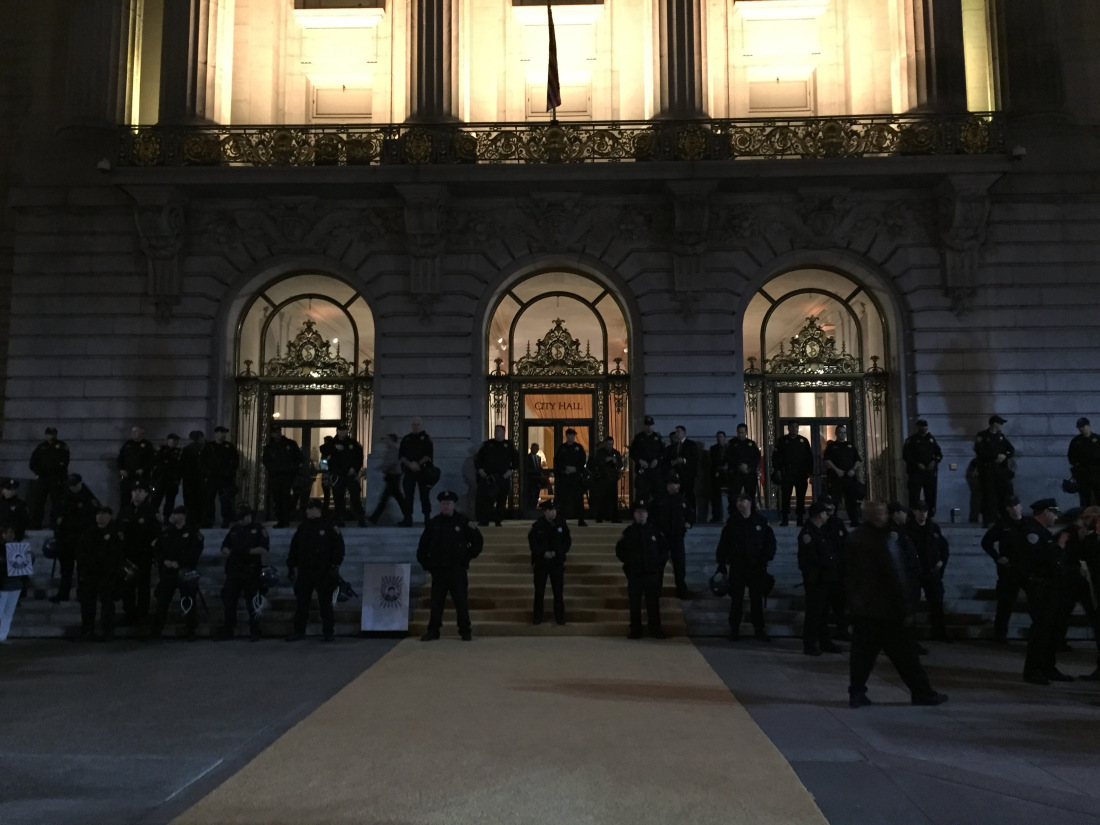
The militarization of police did not receive much mainstream attention until publications broadcasted the use of military-grade weapons against protesters following the highly publicized death of Michael Brown by Ferguson police.
“After Ferguson we saw the armored vehicles, we saw the guys in army gear on top of armored vehicles with long rifles pointed at crowds. Any protests, you see cops lined up in BDU’s or military style uniforms, lined up, at port-arms with a long baton, or a shotgun, or a paintball gun,” Dudley says. “And that’s what people think when they think of militarization of police. The role of the police is not to stand by and let anarchy rule; the role of the police is to step in and stop that kind of violence.”
For Dudley, the militarization of police departments is not the problem in itself, it is how the police exhibit their 1033 equipment.
“My only suggestion to address the military aspect is, don’t go in to any situation looking like the military,” he says. “My suggestion for the 1033 is, anything you get, you pant it just like your own stuff. If your police cars are black and white, you paint the armored vehicle black and white.”
Urban Shield
According to Urban Shield, the event has operated annually in the Bay Area since 2007, attracting local law enforcement agencies, fire departments, medical/EMS responders, and various SWAT teams from the Bay Area and other metropolitan cities in the U.S.. The event has also seen participation from international police forces from countries including Qatar, Bahrain, Singapore, South Korea, Brazil, and even the Israeli and the Mexican Federal Police, both of which are internationally recognized as human rights violators.
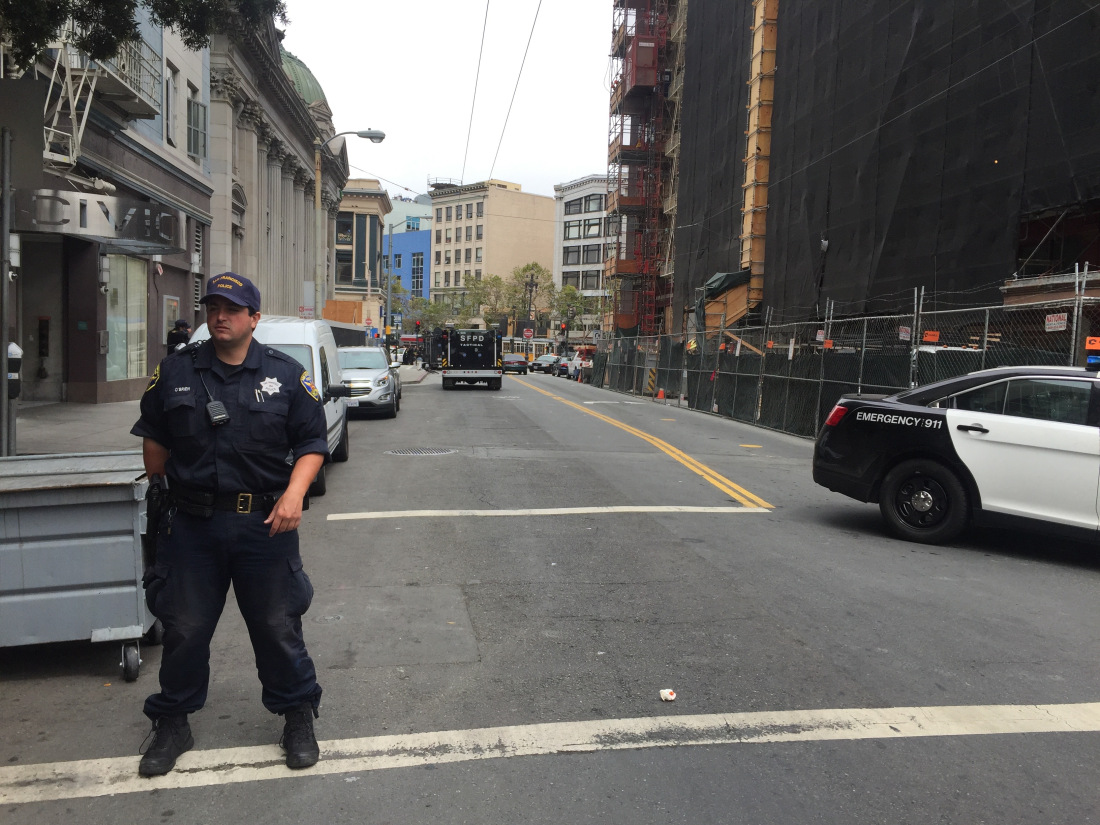
Stop Urban Shield, a coalition of twenty community and social activism organization, including Critical Resistance, have been at the forefront of the fight to end what they define as “48 consecutive hours of international war games competition accompanied by a weapons and militarized equipment trade show.”
This notion of public safety is further challenged by people like John Lindsay-Poland, writer, activist, researcher and analyst focused on human rights and demilitarization, a member of American Friends Service Committee and the Stop Urban Shield Coalition.
“Sometimes there is claim that this being done in order to prepare for natural disaster or prepare for other kinds of emergencies,” Lindsay-Poland says. “But the scenarios, in the SWAT teams and other parts of training, have to have a ‘nexus to terrorism.’ That means terrorism is being prioritized as a threat. Another one of our problems is that although it is training for these extreme situations, the vast majority of deployments of SWAT teams in this area and nationally are not for extreme situations.”
In January of this year, Alameda County Board of Supervisors unanimously approved $5,535,014 million in federal funds from the Bay Area Urban Areas Security Initiative to host the 2017 Urban Shield expo in face of hundreds of protesters. According to the Alameda County Sherriff’s Department, they are pushing for this year’s Urban Shield event, viewing it as necessary training for the safety of the Bay Area.
“We are going to train our people to make the best decisions in very difficult situations, and through those decisions make sure everyone is safer in the long run,” says Sgt. J.D. Nelson, spokesperson for the Alameda County Sheriff’s Department.
According to the Alameda Board of Supervisors, in approving Urban Shield for another year, they set up an Urban Shield tasks force — including non-elected appointees and Stop Urban Shield members — so that voices from the community will be heard.
“It’s a positive step, but there is still more work to be done,” says Lara Kiswani, a member of the task force and Stop Urban Shield Coalition. “It is not going to be won in these meetings, we believe it’ll be won in the streets. So we are definitely still planning on mobilizing to Urban Shield this year if it does in fact happen, and continue initial opposition in all kinds of ways so that people feel compelled to withdraw from their participation and then ultimately no longer host it all together.”
By ending Urban Shield, Kiswani hopes to decline police militarization in the Bay Area so that people like Manzanarez will no longer fear for their lives when encountering police in their neighborhoods.
 Arash Malekzadeh